
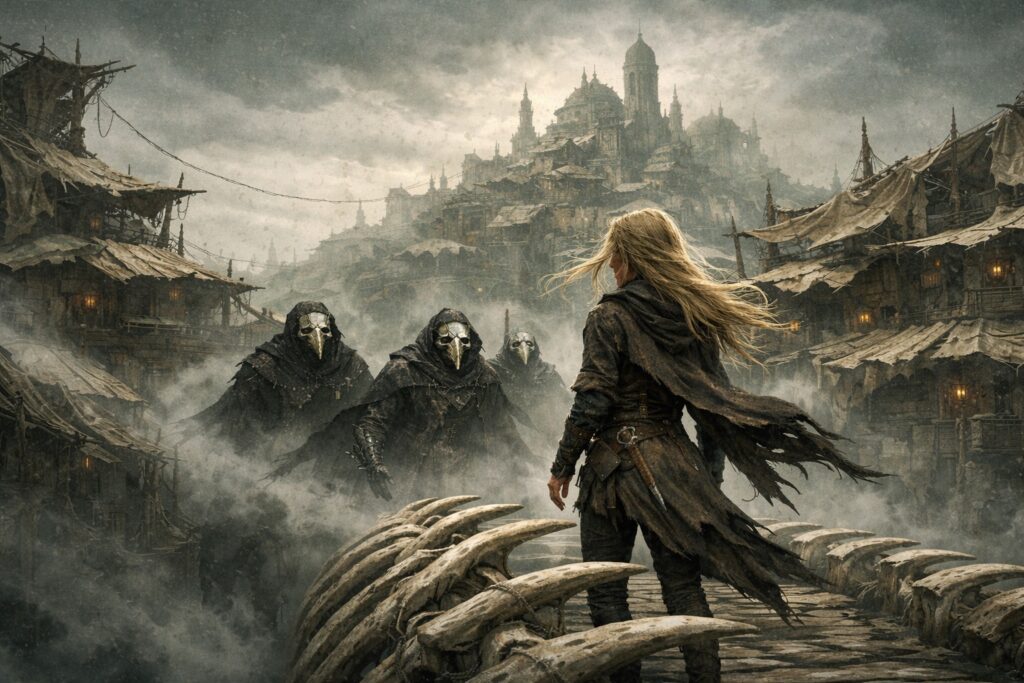
KADRAS - A City Built on Bones
The world of KADRAS is vertical. And that changes everything.
In our first post we talked about what KADRAS is: a dark science fantasy audio adventure with a steampunk edge, built for people who love choices that matter.
Now let us talk about where it takes place.
A city that should not exist
KADRAS is set in a flying city. Not a gleaming utopia in the clouds, but a place that looks like it was assembled from the carcass of something enormous and ancient. Walls made of pressed shells and crusite. Rooftops held up by ribs that once belonged to creatures larger than anything alive today. Rope bridges, rusted cables, and steam-powered lifts connecting levels that were never designed to coexist.
The city floats above the sea, surrounded by storms that never stop. Nobody leaves. Nobody arrives. That is what everyone believes, at least.
Three layers. Three realities.
KADRAS is built vertically, and that vertical structure is not just geography. It is politics. It is culture. It is the story itself.
At the top sits the Crown. Clean stone. Quiet halls. The people who decide what is true and what is forgotten.
In the middle lies the Belt. Workshops. Markets. Gondolas rattling along ancient cables. The people who keep the city running, one improvised repair at a time.
At the bottom waits the Abyss. Narrow alleys between bone-frame shacks. Lanterns that fight a losing battle against the fog. The people who survive because they have no other option.
The higher you climb, the more polished the lies become. The deeper you go, the more honest the violence gets. Our protagonist starts at the bottom.
A protagonist without a past
You wake up. You do not know who you are. You do not know where you come from. The people around you seem to know more about you than you know about yourself, and none of them are willing to share.
That is not a gimmick. That is the engine of the story.
Every conversation becomes a negotiation. Every piece of information has a price. Every person you meet has a reason to help you and a reason to use you. The question is never just “what happened to me?” It is: “who benefits from me not knowing?”
A world that runs on rust
The currency in KADRAS is called Rust. Literal corroded metal discs strung on chains. It tells you everything you need to know about the economy: nothing is new, nothing is clean, and everything is scraped together from what came before.
We spent a lot of time designing a world where scarcity is not just backdrop. It is a mechanic. How much Rust you have, how you spend it, who sees you spend it: these things matter. In the Abyss, showing your money is almost as dangerous as not having any.
Technology they worship but do not understand
One of the ideas we kept coming back to during development was this: what happens when a society inherits technology it cannot reproduce?
KADRAS is full of relics. Light spheres that glow without fuel but shatter forever when broken. Reactors deep in the city’s core that keep it floating, maintained through ritual rather than engineering. Projectors that sometimes show images of places and faces no one recognizes.
The people of KADRAS do not have science. They have tradition. They repeat what the last generation taught them, and each generation understands a little less. Repair is prayer. Maintenance is ceremony. And when something breaks for good, it stays broken.
That slow decay is not just atmosphere. It is the clock ticking underneath the entire story.
Silence has a sound here
We are building KADRAS as an audio experience, and that means the world has to work for your ears. The drip of condensation in a bone-walled corridor. The distant clang of a steam lift engaging. The low drum of a patrol moving through the Abyss, and the silence that falls over a crowd when they hear it coming.
Sound is not decoration. It is how you read the room. It is how you know when a deal is about to go wrong, when someone behind you is following too closely, when a space is safe or just quiet.
We are designing every scene with one rule: if you close your eyes, the world should still be there.
What is the city hiding?
Every society tells itself a story about where it came from. KADRAS is no different.
The official version is simple: the city was built to escape a great flood. The founders were heroes. The storms protect. The system works.
We are not going to tell you what the real story is. Not yet. But we will say this: the gap between the official history and the actual history is where the entire plot lives. And by the time you start pulling at that thread, you will understand why some people in KADRAS would rather kill than let the truth come out.
Choices in the vertical city
The vertical structure of KADRAS creates a specific kind of decision space. Moving between layers is not free. It costs Rust, favours, or risk. Every time you choose to go somewhere, you are choosing who sees you, who you owe, and what you are willing to trade.
That is the kind of choice we care about. Not “left door or right door.” But: “Do I stay invisible and safe, or do I step into the light and find out what it costs?”
What comes next
In the next post, we will talk about the people who inhabit this world. Not the names and backstories, not yet. But the roles, the tensions, and the kind of relationships that form when trust is the scarcest resource in a dying city.
Stay close. The storms are getting louder.