
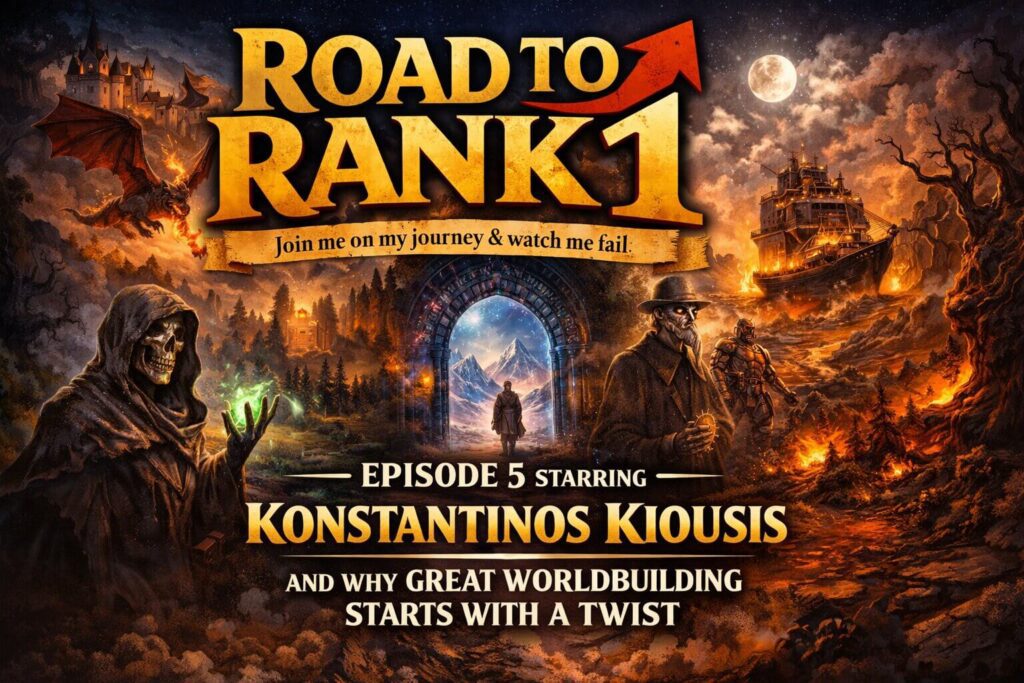
Konstantinos Kiousis and Why Great Worldbuilding Starts with a Twist
I have a plan. It's not a good plan. Let’s goooo!
Christian Mahnke, Road to Rank 1
I started this series because I want to become a better writer, and ideally not by spending the next ten years making the same avoidable mistakes in private.
So my strategy has been simple: talk to people who have already spent years thinking seriously about storytelling, worldbuilding, structure, character, and craft, then publish what I learn before I have time to pretend I knew it already.
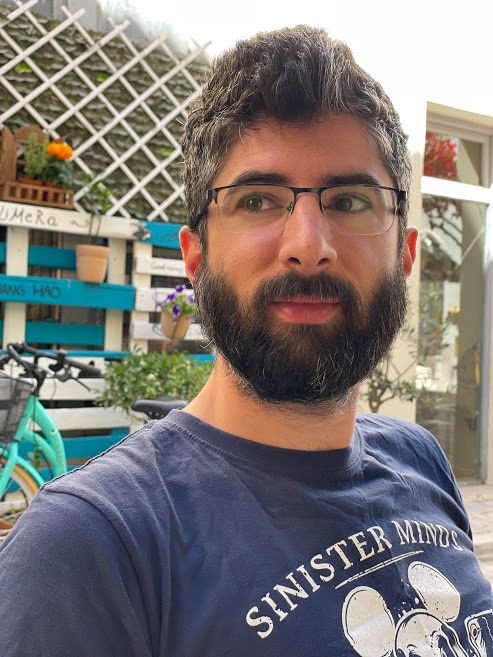
This time, I spoke with Konstantinos Kiousis, a writer whose storytelling roots run from fairy tales and Edgar Allan Poe to Dungeons & Dragons, horror anthologies, dark fantasy, mystery, and worldbuilding for a wargame project. He has had stories featured on the NoSleep Podcast, has published short fiction with small traditional publishers, and, like many of the people I find most interesting, he seems to think about story not as content production, but as a way of living inside questions.
Which, unfortunately for me, made this one of those conversations that sounds inspiring on the surface and then slowly starts judging your own half-built worlds from inside your skull.
Because what Konstantinos said about worldbuilding was not flashy. It was structural. And the more we talked, the more I realized that many fictional worlds fail not because they lack imagination, but because they lack one of three things:
A real hook.
A clear rule set.
Or characters strong enough to make the world matter.
Getting in touch with Konstantinos Kiousis
The Best Worlds Start with Something Familiar, Then Break It
One of Konstantinos’ strongest points was also one of the simplest.
If you want to build a world people care about, start with something familiar, then twist it.
That twist is what creates the hook.
His example from A Song of Ice and Fire was perfect. Winter is something everyone understands. But George R. R. Martin turns it into something bigger, stranger, and more threatening. It is not just weather. It is a long-term condition of the world. A fear. A prophecy. A pressure system hanging over politics, war, class, survival, and identity. “Winter is coming” works because it is both literal and symbolic. It reshapes how people live.
That idea stayed with me.
Because many fantasy worlds try to impress you with scale first. More kingdoms, more gods, more maps, more terminology, more ancient relics with apostrophes in their names. But a strong world does not begin with quantity. It begins with one strong, destabilizing idea that changes how people behave.
Konstantinos even gave a brutal example: imagine a world where acid rain falls every few weeks. Immediately you start asking the right questions. How do people build houses? How do they travel? What do they wear? How is food stored? What rituals, fears, warnings, and class systems would emerge around that reality?
That is useful because it forces worldbuilding away from decoration and toward consequence.
And that may be one of the cleanest lessons I’ve taken from this whole series so far:
a world becomes interesting when its premise changes human behavior.
One Piece and the Discipline of Controlled Chaos
We also talked about One Piece, which at first glance looks like the complete opposite of Game of Thrones.
Where Martin builds dread and political density, Eiichiro Oda builds expansive unpredictability. Pirate crews travel from island to island through a world where nearly anything can happen. Entire locations can feel absurd, impossible, surreal. Characters gain bizarre powers through Devil Fruits. The tone can swing wildly. The physics are flexible. The imagination is almost offensively unconstrained.
And yet it works.
Why?
Because the chaos is still governed by rules.
That distinction matters.
Konstantinos put it very clearly: readers can accept almost anything if they understand the internal logic of the world. The problem is not weirdness. The problem is arbitrariness.
That was one of the most useful lines in the whole conversation for me, because it applies everywhere, not just to fantasy epics and anime. It applies to interactive fiction, audio stories, games, thrillers, even comedy. Audiences do not need realism. They need trust. They need to feel that what happens next grows from what the world already is, not from what the author suddenly needs.
The moment a story feels like the writer is just pulling something out of thin air to solve a plot problem, trust starts to collapse.
That is also why, in our conversation, we ended up criticizing one specific move in A Song of Ice and Fire: resurrection.
Not because fantasy cannot include resurrection. Obviously it can. But because when a world has trained you to believe death matters, bringing characters back changes the emotional contract. It risks shifting the story from “actions have consequences” toward “the rules can bend when needed.”
And once readers suspect that, tension changes.
That point hit home for me because it is very easy, especially when building big fictional systems, to fall in love with possibilities. But possibilities are not enough. A world needs limits. Otherwise nothing costs anything.
The Characters Are Not Standing in the World. They Are the World.
One of the things I appreciated most about Konstantinos is that, for all the talk about worlds, systems, hooks, and rules, his approach is deeply character-driven.
When I asked him whether he starts with the world or the story, his answer was basically: neither. He starts with people.
Or more precisely, with the feeling of people.
He described beginning with powerful figures, rulers, mages, personalities, and then building outward from them. A tower becomes a city. A city becomes a social order. A social order becomes a wider world. Other characters appear, and through their backgrounds, customs, fears, and ambitions, more of the world reveals itself.
That makes intuitive sense to me.
Because in the end, readers do not experience your world as a wiki. They experience it through someone who is hungry, bitter, loyal, frightened, ambitious, exiled, trapped, obsessed, in love, or trying not to die.
We also touched on one of George R. R. Martin’s real strengths here. It is not only that he created an elaborate political setting. It is that his characters feel like products of that setting. The factions are recognizable. The names are memorable. The houses have identities. Even minor figures often carry one distinct visual or behavioral trait that lets them stick in your mind. The world is not delivered to you as exposition. It is embodied.
That is why flat characters kill even impressive worldbuilding.
You can invent the most interesting magical system in the world. You can design ten religions, five continents, and a civil war over divine bloodline inheritance. But if the people moving through that world feel generic, nobody cares. They are not reading for your database. They are reading for emotional traction.
And what Konstantinos said, in different words, is that characters are not ornaments inside a world. They are the way the world becomes legible.
A Good World Makes You Ask Better Questions
There was another thing I found valuable in this conversation, and it was less technical.
Konstantinos talked about worldbuilding as something that can emerge through long internal conversations with characters. He described it almost as if the characters arrive first and tell him where they came from, what shaped them, what kind of place could have produced them.
I like that.
Partly because it is romantic and slightly unhinged, which is often a promising sign in storytelling. But mainly because it points to something practical: good worldbuilding is often not about having all the answers. It is about asking the right questions early enough.
If your world has a dangerous winter, how does that affect faith, food, and war?
If magic is tied to emotion, what kind of people gain power most easily?
If a plague altered animals and humans 500 years ago, what myths survive around its origin?
If a city is ruled by mages, what does failure look like for the people outside its gates?
A strong fictional world does not just provide scenery. It generates questions that produce stories.
That, I think, is the difference between a world that feels large and one that actually is alive.
The Three Things I’m Taking from This
If I reduce the whole conversation to the parts I want to keep in front of me while writing, it comes down to this:
- Build your world around a strong destabilizing hook.
Start with something recognizable, then twist it until it changes how people live. - Make the rules clear enough that the audience can trust the world.
Strangeness is good. Arbitrariness is not. - Let characters embody the world instead of merely walking through it.
If the people are compelling, the world becomes compelling with them.
That may not be the secret formula for becoming a bestselling writer. Sadly, nobody in this series has offered me that yet in a way that avoids effort.
But it is a very good test.
If I cannot explain what makes my world distinct, what rules govern it, and how my characters express it, then I probably do not yet have a world. I have fragments.
And that is useful to know.
Konstantinos, thank you. This one gave me exactly what I wanted from Road to Rank 1: not comfort, but sharper criteria.
About Road to Rank 1
Road to Rank 1 is my public learning series about becoming a better writer of interactive fiction and audio stories by talking to experts from games, books, audio, and narrative design.