
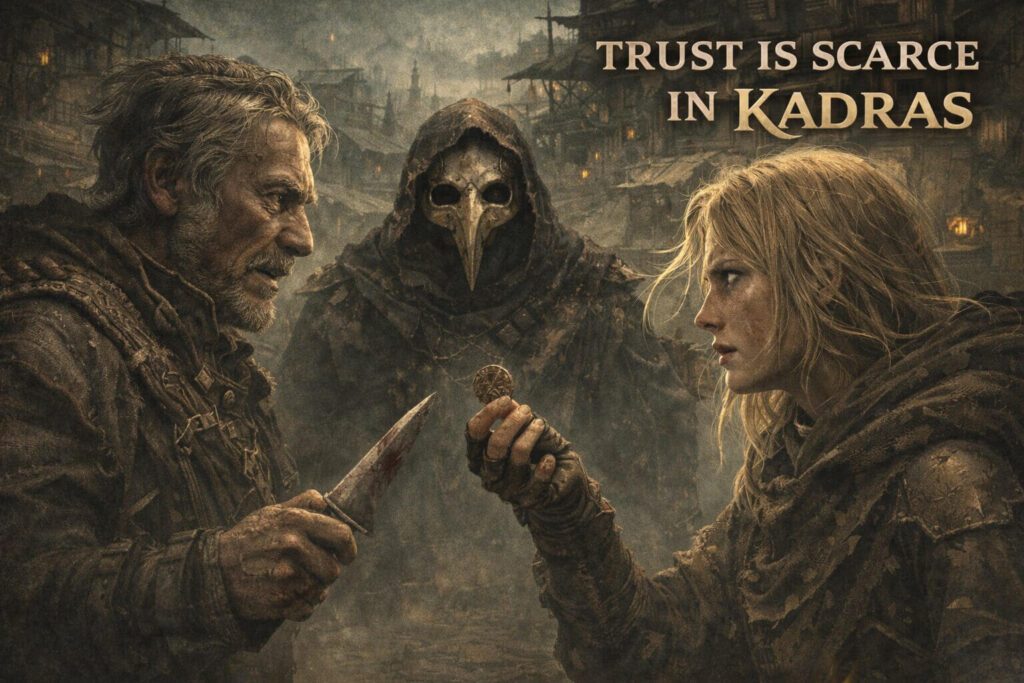
The People of Kadras
Trust is the scarcest resource in a dying city.
In the last post we talked about the streamers joining Kadras as voice actors. Before that, we walked through the world: its layers, its rust economy, its inherited technology nobody fully understands anymore.
We promised we would talk about the people.
Here we go.
Nobody is just what they appear to be
In most fantasy worlds, the blacksmith is a blacksmith. The guard is a guard. The merchant wants your money.
Kadras does not work that way.
Every person you meet is running something on the side. A favor owed. A secret kept. A deal that technically never happened. Not because everyone is corrupt, but because in a city this closed, this vertical, this short on resources, specialization is a luxury most people cannot afford.
The woman who runs the tavern in the Abyss knows three things you need to know. She will not give them to you for free. And she will not tell you which three.
Relationships are a form of currency
We talked about Rust last time. The literal corroded metal that drives commerce in Kadras.
But there is a second economy running underneath it, one that does not have a name but everyone operates in: the economy of obligation.
Who owes you a conversation. Who you owe a silence. Who you have helped enough that they might look the other way once. Who knows where you slept last week and has not mentioned it.
This is not background flavor. It is a mechanic. The choices you make in Kadras are tracked not just by what you acquire, but by who notices, who remembers, and what they expect in return.
Three archetypes. Three kinds of danger.
The people of Kadras tend to sort themselves into recognizable shapes. Not roles. Not jobs. Shapes.
The ones who know more than they say. They are everywhere. In the Abyss they are survivors. In the Belt they are middlemen. In the Crown they are strategists. The same posture, three different power levels. They will help you if it helps them. The question is always: what are they actually buying?
The ones who have already decided. They picked a side, a faction, a cause, a debt they intend to collect. They are not negotiating. They are executing. Some of them will try to pull you in. Some will try to use you as a tool. A few will become the most reliable people in your world, precisely because you know exactly what they want.
The ones the city has not broken yet. They still ask questions. They still get surprised. They are usually younger, always reckless, and occasionally right about something that everyone else stopped believing in years ago. In a city like Kadras, that kind of belief is either the most dangerous thing or the most valuable. Sometimes both.
The people you meet in the Abyss
Our story begins at the bottom.
The Abyss is loud in the wrong ways. Arguments through thin walls. A patrol moving through a crowd that goes quiet a half-second before they arrive. The sound of a deal going wrong in the alley behind the tavern, and then nothing.
The people down here are not villains. They are people who stayed too long, slid too far, or were born into a level of the city where survival is the only career track. Most of them are exhausted. A few are dangerous because of it.
What makes them interesting is not their suffering. It is their precision. When you have no margin for error, you get very good at reading a room.
These are the people who will tell you things the upper city does not know you can find out. If you earn it.
What Ilana walks into
You arrive in Kadras without a past. That is already unusual. Everyone here has a past. Everyone has a story about where they came from, even if the story is a lie.
A person without a past is either an opportunity or a threat. In the Abyss, they will test which one you are before they decide how to treat you.
The characters you meet in the first episodes are not there to explain the world to you. They are there to want things from you. Help. Labor. Information. A witness. A body in the room that makes their situation slightly more manageable.
Whether you become useful, dangerous, or invisible to them is, as always, your call.
What comes next
In the next post, we will go deeper into how decisions actually work in Kadras: the mechanics behind the choices, why some moments branch and others converge, and what it means for a story to track who you are without ever stopping to ask.
The city is still listening. So are we.