
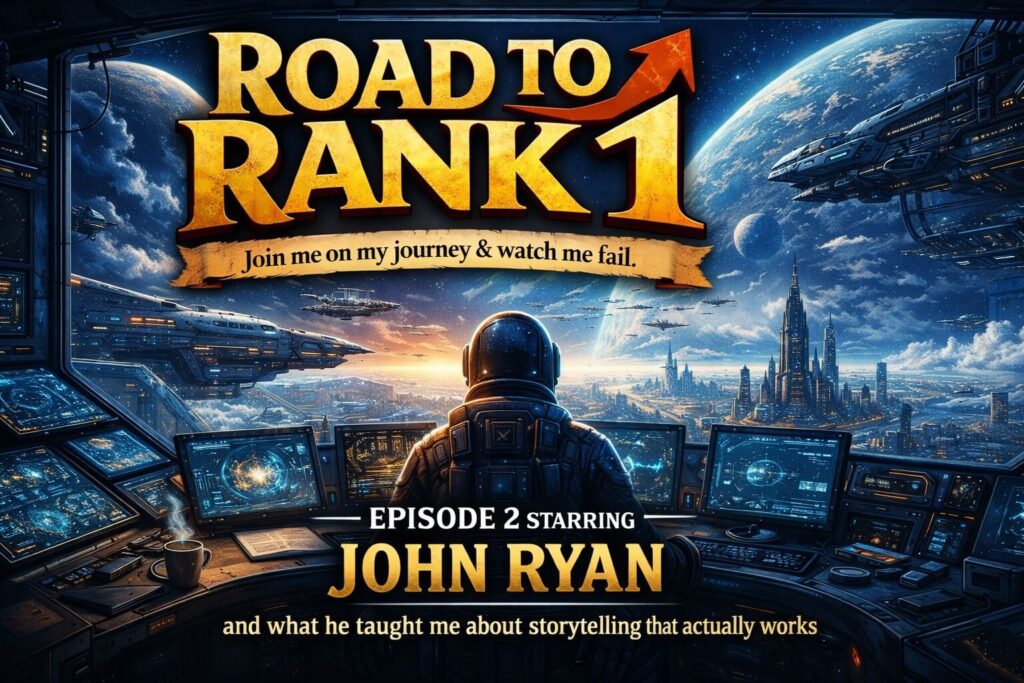
John Ryan and what he taught me about storytelling that actually works
Road to Rank 1 - Episode 2
I have a plan. It's not a good plan. Let’s goooo!
Christian Mahnke, Road to Rank 1
Let me be honest with you.
At EarReality we build interactive audio stories. We’re about to relaunch TWIST Tales soon – our platform for interactive audiobooks, self-publishing, and a creator economy for writers who want to do something genuinely new with storytelling.
And I haven’t written seriously in years.
So naturally, I decided the best way to fix that is to call up some of the best storytellers in the world, ask them to explain their craft to me, and publish the whole conversation publicly so you can all watch me figure it out.
Welcome to Road to Rank 1 – my completely unreasonable goal of becoming the world’s most renowned writer of interactive fiction and audio stories.
I know. I know.
But someone has to try.
My second call: John Ryan, Narrative Designer on Fable, Destiny & Horizon
John Ryan has been working in games for over 18 years. He didn’t come through the traditional route, because there was no traditional route for game narrative back then. He started in journalism, moved into game reviews at MSNBC, and got his first job in the games industry through a Craigslist posting at Microsoft Game Studios.
From there he worked his way through some of the most respected franchises in the medium – writing on Fable II, contributing lore on Guild Wars 2, serving as lore editor on Destiny during the House of Wolves and The Taken King expansions, lead writing on Forza Motorsport 7, and working as senior writer on Horizon Forbidden West.
He’s also worked on Iron Man VR, Lily’s Garden, June’s Journey, and currently works as a narrative consultant and senior writer/narrative designer for unannounced projects.
In other words: if you’ve played a big game in the last two decades, there’s a reasonable chance John had something to do with how it felt to be inside its world.
I asked him everything I’ve been too busy to think about properly.
Here’s what landed.
You can't force story where there's no room for it
The first thing John said that I genuinely needed to hear:
“You can’t force a story into a space where it doesn’t belong.”
If a game is fast and playful, story needs to step back and let gameplay breathe. If it’s slow and immersive, story can do more of the work. The mistake – and I’ve felt this in my own writing without ever being able to name it – is trying to do both at once, without understanding what your format actually allows.
When that happens, things go wrong. Pacing breaks. Scenes feel intrusive. Players disconnect. Not because the writing is bad, but because it’s in the wrong place.
For interactive audio stories, this hits close to home. The format has its own rules. Voice has rhythms that a page doesn’t. I’ve written scenes that would work beautifully as prose and fall completely flat when someone is listening through earphones on their commute. John’s framing helped me understand why.
The question underneath everything
When I asked John about his go-to technique – the thing he comes back to when a project starts drifting – he didn’t give me a framework. He gave me a question.
What is the central question of this story?
Not the plot. Not the setting. The question underneath everything.
Who am I, where do I come from, and what is my place in the world?
He uses the question above to frame Horizon Zero Dawn’s overall narrative. One question runs from the opening of that game to its final moments. That question tells you what to write – and just as importantly, what to cut. Everything that doesn’t serve it is cut.
I went back to a story I’ve been sitting on after our call and asked myself the same thing. I didn’t have a good answer. That told me more than I wanted to know.
Transmedia isn't a shortcut
We spent time on transmedia, partly because it’s something I think about a lot for TWIST Tales. The instinct many studios have is to use it as a growth lever – make a book, pitch a series, build out the universe. Announce the expanded world before anyone has even finished the game.
John was more patient than that.
“You can’t just do a full-court press before the audience is there. It almost feels artificial.”
What actually works, he said, is watching what resonates and following it. Team Fortress 2 didn’t push heavily transmedia from day one. The “Meet the Team” videos were promotional materials and the comics came later, once the characters had clearly caught on. Tracer became the face of Overwatch in part because the players grew to love her. Pikachu wasn’t meant to be the mascot of Pokémon. The audience made that call.
The pattern is consistent: validate first, expand second.
For TWIST Tales, where we’re building around creator-driven interactive audio stories, this is genuinely useful. You don’t build the universe and then look for the audience. You find what connects – and then you build.
Why copying great games doesn't work
We ended up talking about FromSoftware – because of course we did – and the long line of Souls-like games that have tried to replicate what they built.
Most of them fail. John explained why in a way I haven’t heard put quite this clearly before:
“They copy the surface. The difficulty, the mechanics, the aesthetic. But they miss why all of those things work together.”
Elden Ring isn’t a template. It’s the result of a studio that has been learning quietly across every game it has made, from Demon’s Souls onwards. Each title builds on the last. What you’re playing is years of accumulated knowledge – and no one can copy that, because it isn’t a formula. It’s earned.
Coming from someone who has maintained narrative consistency across sprawling IPs like Destiny and Guild Wars 2, this landed differently than it would from someone just looking in from the outside. John knows what it actually takes to build something that holds together across years and sequels and expansions.
The part I didn't want to hear
Eventually the conversation turned to something more personal.
I told John I’d stepped away from writing for a while. That other things had taken over. That I kept meaning to get back to it.
He didn’t let me off the hook.
“Don’t just have something always in your drawer. Get something done. Because you’ll learn from that and you will grow. You’ll use it as a stepping stone to something bigger.”
He also brought up Hayao Miyazaki – not FromSoftware’s Hidetaka Miyazaki, but the animation director – who famously doesn’t create by thinking about what the audience wants. And yet everything he makes lands emotionally. John’s point was that the balance isn’t between pleasing the audience and ignoring them. It’s about separating the act of creation from the act of evaluation. You write from instinct. Then you listen.
But only if you actually finish something to listen about.
What I'm taking into the next episode
Road to Rank 1 is not going to be a series where I interview experts, tidy up their advice, and present it like I already understood it.
It’s going to be messier than that. Because I’m actually trying to apply this – in public – on interactive audio stories I’m writing alongside these conversations.
Some of it will work. Some of it won’t.
But nothing is staying in the drawer.
If you’re a writer, game designer, voice actor, UX designer, or anyone else who thinks seriously about storytelling – and you’d like to be part of a future Road to Rank 1 conversation, or contribute to the TWIST Tales & Friends book I’m putting together – I’d genuinely love to hear from you.
And if you want to know when TWIST Tales goes live – with self-publishing, creator profiles, and a home for interactive audio stories – follow along here.
John, thank you. This was exactly the call I needed two years ago.
Next episode coming soon.
About Road to Rank 1
Road to Rank 1 is my public learning series about becoming a better writer of interactive fiction and audio stories by talking to experts from games, books, audio, and narrative design.